Class B box truck: weight classes and what each one means
People search for a "Class B box truck" meaning two different things: the CDL class you need to drive it, or the weight class the truck belongs to. They are different systems, and a 26 ft box truck can be "Class 6" by weight and need no CDL at all. This page untangles the classes, shows where common box trucks fall on one chart, and lists what each class means for your license, your DOT paperwork and IFTA.
Key finding
The 26,000 lb line decides almost everything for a 26 ft box truck. One pound more on the GVWR moves the truck from weight Class 6 to Class 7, and brings a Class B CDL, drug and alcohol testing and, on a two-axle truck, IFTA.
Three different "classes" for the same truck
| System | Who uses it | Classes | A typical 26 ft non-CDL box truck |
|---|---|---|---|
| Weight class (GVWR) | Manufacturers, DOT, dealers | 1 to 8 | Class 6 (19,501 to 26,000 lb) |
| CDL class | Licensing (49 CFR 383.91) | A, B, C | None needed at 26,000 lb; Class B at 26,001 lb or more |
| FHWA vehicle class | Traffic counts | 1 to 13 | Class 5: two axles, six tires, single unit |
When a broker or a job post says "Class B truck," they almost always mean the license: a truck heavy enough to need a Class B CDL. When a dealer says "Class 6," they mean the weight rating.
Truck weight classes chart
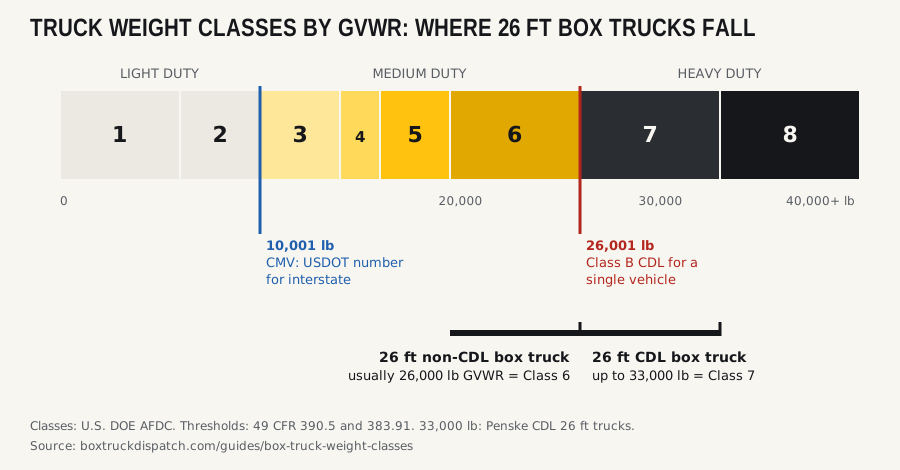
| Weight class | GVWR | Duty | Box trucks you'll see here |
|---|---|---|---|
| Class 3 | 10,001 to 14,000 lb | Medium | Small cutaway box trucks |
| Class 4 | 14,001 to 16,000 lb | Medium | Mid-size cutaway box trucks |
| Class 5 | 16,001 to 19,500 lb | Medium | Larger cutaway and light medium-duty trucks |
| Class 6 | 19,501 to 26,000 lb | Medium | Most 22 to 26 ft non-CDL box trucks |
| Class 7 | 26,001 to 33,000 lb | Heavy | Heavy-spec 24 to 26 ft box trucks (CDL) |
| Class 8 | over 33,000 lb | Heavy | Heavy straight trucks and tractors |
Classes 1 and 2 (up to 10,000 lb) are pickups and vans, below the federal commercial motor vehicle line for most rules. GVWR is the weight rating the manufacturer puts on the door-jamb sticker: the most the loaded truck may weigh. How much of that is left for cargo is covered in how much weight a box truck can carry.
Class B CDL box truck: when you need one
Under 49 CFR 383.91, Group B is a "heavy straight vehicle": any single vehicle with a GVWR of 26,001 lb or more. A box truck is a straight truck, so a box truck rated 26,001 lb or more needs a Class B CDL. Two details catch people out:
- Actual weight counts too. The CMV definition in 49 CFR 383.5 uses GVWR or gross vehicle weight, whichever is greater. Overload a 26,000 lb truck to 26,500 lb and it becomes a vehicle that needs a CDL.
- Hazmat changes everything. Placarded hazardous materials need a CDL with a hazmat endorsement at any weight.
So do you need a Class B to drive a box truck? For most 26 ft trucks, no: they are built at 26,000 lb for exactly that reason. The full test, with how to read the sticker, is in do you need a CDL to drive a box truck, and the CDL checker gives you the answer for your truck in seconds.
Class 6 vs Class 7: the trade-off
| 26 ft at 26,000 lb (Class 6) | 26 ft at up to 33,000 lb (Class 7) | |
|---|---|---|
| License | Regular license | Class B CDL |
| Payload | Capped by the 26,000 lb rating | Several thousand lb more |
| Drug and alcohol testing (Part 382) | Not required | Required (CDL drivers) |
| IFTA on a two-axle truck | Usually not a qualified vehicle | Qualified (over 26,000 lb) |
| Driver pool | Anyone with a clean license and medical card | CDL holders only |
Penske's CDL 26 ft rentals, for example, are rated up to 33,000 lb. Our view from the dispatch desk: most box truck freight is cube-limited partials and LTL that fit a 26,000 lb truck, so we see far more non-CDL 26-footers. A Class 7 truck pays off if you know you will haul dense freight like beverages, paper or building materials.
What each weight class means for DOT and IFTA
For a for-hire box truck running interstate, the rules stack up by weight:
| Rule | Classes 3 to 6 (10,001 to 26,000 lb) | Classes 7 and 8 (26,001 lb and up) |
|---|---|---|
| USDOT number (interstate) | Yes, a CMV at 10,001 lb or more (49 CFR 390.5) | Yes |
| MC authority (for-hire interstate) | Yes | Yes |
| DOT medical card | Yes | Yes |
| Hours of service and ELD | Yes, unless an exception applies | Yes, unless an exception applies |
| Annual inspection | Yes | Yes |
| CDL | No (unless hazmat) | Class B (single truck) |
| Drug and alcohol testing | No | Yes |
| IFTA (two-axle truck) | Usually not qualified | Qualified |
IFTA applies to qualified motor vehicles: two axles and over 26,000 lb, three or more axles, or a combination over 26,000 lb, per the IFTA Articles of Agreement. Details and what records to keep anyway are in do box trucks need IFTA.
Class B straight trucks beyond box trucks
The same Class B rule covers every heavy straight truck: dump trucks, stake bodies, larger tow trucks and heavy box trucks alike. If you drive any single truck rated 26,001 lb or more, you need a Class B. That is also why a Class B license is common among delivery and construction drivers. The license is the same; what the truck carries is not.
Class B trucking school and getting the license
Since February 7, 2022, anyone getting a Class B CDL for the first time, or upgrading to one, must complete entry-level driver training from a provider listed on FMCSA's Training Provider Registry before taking the skills test (49 CFR 380.609). The usual path:
- Get a commercial learner's permit from your state (knowledge test and DOT medical card).
- Complete entry-level driver training (theory and behind-the-wheel) with a registered provider. Check that the school is on the Training Provider Registry before you pay.
- Pass the state skills test in a Class B vehicle. Test in a truck with air brakes if you want to avoid an air brake restriction.
Prices and course length vary by school and state, so compare a few registered providers.
Which class should your box truck be?
If you are buying one truck for freight, a 26 ft truck at 26,000 lb is the flexible choice: any licensed driver can run it, and it fits most posted box truck loads. Go Class 7 when your freight is heavy and steady enough to justify CDL drivers. Either way, our box truck dispatchers only book loads that keep the truck inside its rating.
General information about federal rules as checked in October 2026, not legal advice. States can add their own rules for intrastate trucks.
FAQ
Do you need a Class B to drive a box truck?
Only if the truck's GVWR, or its actual weight, is 26,001 lb or more, or it hauls placarded hazmat (which needs a CDL with a hazmat endorsement). Most 26 ft box trucks are rated 26,000 lb and can be driven on a regular license. Check the GVWR on the door-jamb sticker.
What is a Class B truck?
In licensing, a Class B truck is a single vehicle with a GVWR of 26,001 lb or more, the CDL Group B 'heavy straight vehicle' in 49 CFR 383.91. Box trucks, dump trucks and other straight trucks at that weight all need a Class B CDL. Weight classes, by contrast, are numbered 1 to 8.
What weight class is a 26 ft box truck?
Usually Class 6 (19,501 to 26,000 lb GVWR), because most 26 ft trucks are built at exactly 26,000 lb to stay non-CDL. A heavy-spec 26 ft truck rated 26,001 to 33,000 lb is Class 7.
Is a Class B CDL box truck worth it over a non-CDL truck?
It carries more weight: a 33,000 lb GVWR truck can carry several thousand pounds more than a 26,000 lb one, which opens dense freight. In exchange you need CDL drivers, drug and alcohol testing, and the truck usually qualifies for IFTA. Most box truck freight fits a non-CDL truck, so heavy-spec trucks make sense for owners who know they will haul heavy loads.
How do I get a Class B CDL?
Get a commercial learner's permit, complete entry-level driver training from a provider on FMCSA's Training Provider Registry (required for first-time Class A and B applicants since February 7, 2022 under 49 CFR 380.609), then pass your state's skills test in a Class B vehicle.
Sources
- U.S. DOE Alternative Fuels Data Center: vehicle weight classes and categories (checked October 2026)
- FHWA Traffic Monitoring Guide, Appendix C: vehicle types (13 classes) (checked October 2026)
- 49 CFR 383.91, commercial motor vehicle groups (checked October 2026)
- 49 CFR 383.5, definitions (commercial motor vehicle) (checked October 2026)
- 49 CFR 390.5, definitions (commercial motor vehicle, 10,001 lb) (checked October 2026)
- 49 CFR 380.609, entry-level driver training requirements (checked October 2026)
- 49 CFR 382.103, drug and alcohol testing applicability (checked October 2026)
- IFTA Articles of Agreement (qualified motor vehicle, R245), January 2026 (checked October 2026)
- Penske Truck Rental: 26 ft box truck (CDL) specifications (checked October 2026)