Non-CDL box truck rules by state
Non-CDL box truck rules come in two layers. The federal layer, which covers the CDL line and everything a truck needs to cross state lines, is the same in every state. The state layer, which covers trucks that never leave their home state, is not. This page puts both side by side: one rule set that never changes, and a 50-state table of what we could verify about the other.
Key finding
Whether a 26,000 lb box truck that never leaves its home state needs a USDOT number depends on the state. FMCSA lists 38 states plus Puerto Rico that require one for intrastate trucks, and the weight lines differ: California's motor carrier permit starts at 10,001 lb, while Texas carrier registration starts above 26,000 lb.
The rules that are the same in every state
These come from federal law and apply wherever you run:
- CDL line. A single vehicle needs a Class B CDL at a GVWR, or actual weight, of 26,001 lb or more (49 CFR 383.91). A box truck at 26,000 lb or less needs a regular license, unless it hauls placarded hazmat. States issue CDLs under this federal standard.
- Interstate trucks over 10,000 lb. A box truck of 10,001 lb or more used in interstate commerce is a commercial motor vehicle (49 CFR 390.5). It needs a USDOT number, MC authority if for-hire, a DOT medical card for the driver, hours-of-service compliance, an annual inspection and the federal insurance minimums. Our box truck DOT requirements guide lists them all by weight.
"Interstate" is broader than crossing a state line yourself. Freight that started or will end in another state can make an in-state haul interstate commerce. If you haul for brokers, assume interstate rules apply.
Want the license answer for your exact truck? Read do you need a CDL to drive a box truck, or run the CDL checker.
States that require a USDOT number for intrastate trucks
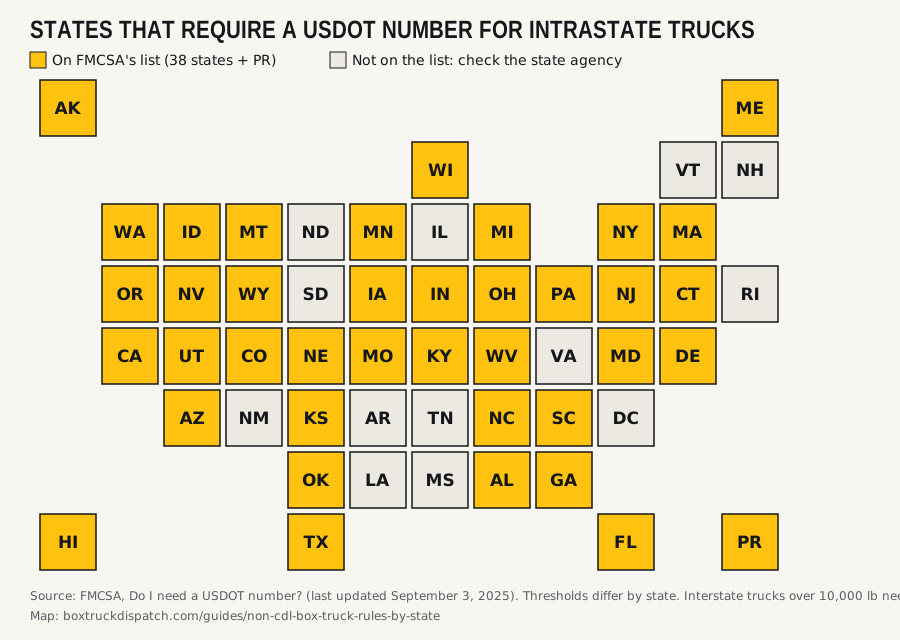
FMCSA's list says which states require a USDOT number for intrastate registrants. It does not say at what weight, and FMCSA itself tells carriers to check with the state agency. A state that is not on the list can still have its own registration, permit or safety rules for in-state trucks.
Non-CDL box truck rules: 50-state table
| State | On FMCSA's intrastate USDOT list | State detail we verified |
|---|---|---|
| Alabama | Yes | Not checked yet: ask the state motor carrier agency |
| Alaska | Yes | Not checked yet: ask the state motor carrier agency |
| Arizona | Yes | Not checked yet: ask the state motor carrier agency |
| Arkansas | No | Not checked yet: ask the state motor carrier agency |
| California | Yes | USDOT number required before a CA number under CVC 34507.5(a)(1) (CHP); DMV Motor Carrier Permit for commercial vehicles of 10,001 lb GVWR or more and all for-hire carriers; 90-day maintenance inspections (CVC 34505.5) |
| Colorado | Yes | Not checked yet: ask the state motor carrier agency |
| Connecticut | Yes | Not checked yet: ask the state motor carrier agency |
| Delaware | Yes | Not checked yet: ask the state motor carrier agency |
| District of Columbia | No | Not checked yet: ask the state motor carrier agency |
| Florida | Yes | Intrastate trucks under 26,001 lb (no placarded hazmat) are exempt from the general adoption of federal rules but must follow 49 CFR 382, 392, 393, 396.3(a)(1) and 396.9 (Fla. Stat. 316.302(2)(f)); intrastate HOS allows 12 hours driving (316.302(2)(b)) |
| Georgia | Yes | Not checked yet: ask the state motor carrier agency |
| Hawaii | Yes | Not checked yet: ask the state motor carrier agency |
| Idaho | Yes | Not checked yet: ask the state motor carrier agency |
| Illinois | No | Not checked yet: ask the state motor carrier agency |
| Indiana | Yes | Not checked yet: ask the state motor carrier agency |
| Iowa | Yes | Not checked yet: ask the state motor carrier agency |
| Kansas | Yes | Not checked yet: ask the state motor carrier agency |
| Kentucky | Yes | Not checked yet: ask the state motor carrier agency |
| Louisiana | No | Not checked yet: ask the state motor carrier agency |
| Maine | Yes | Not checked yet: ask the state motor carrier agency |
| Maryland | Yes | Not checked yet: ask the state motor carrier agency |
| Massachusetts | Yes | Not checked yet: ask the state motor carrier agency |
| Michigan | Yes | Not checked yet: ask the state motor carrier agency |
| Minnesota | Yes | Not checked yet: ask the state motor carrier agency |
| Mississippi | No | Not checked yet: ask the state motor carrier agency |
| Missouri | Yes | Not checked yet: ask the state motor carrier agency |
| Montana | Yes | Not checked yet: ask the state motor carrier agency |
| Nebraska | Yes | Not checked yet: ask the state motor carrier agency |
| Nevada | Yes | Not checked yet: ask the state motor carrier agency |
| New Hampshire | No | Not checked yet: ask the state motor carrier agency |
| New Jersey | Yes | Not checked yet: ask the state motor carrier agency |
| New Mexico | No | Not checked yet: ask the state motor carrier agency |
| New York | Yes | Not checked yet: ask the state motor carrier agency |
| North Carolina | Yes | Not checked yet: ask the state motor carrier agency |
| North Dakota | No | Not checked yet: ask the state motor carrier agency |
| Ohio | Yes | Not checked yet: ask the state motor carrier agency |
| Oklahoma | Yes | Not checked yet: ask the state motor carrier agency |
| Oregon | Yes | Not checked yet: ask the state motor carrier agency |
| Pennsylvania | Yes | Not checked yet: ask the state motor carrier agency |
| Puerto Rico | Yes | Not checked yet: ask the state motor carrier agency |
| Rhode Island | No | Not checked yet: ask the state motor carrier agency |
| South Carolina | Yes | Not checked yet: ask the state motor carrier agency |
| South Dakota | No | Not checked yet: ask the state motor carrier agency |
| Tennessee | No | Not checked yet: ask the state motor carrier agency |
| Texas | Yes | TxDMV motor carrier registration for intrastate vehicles over 26,000 lb (gross, registered or rated weight); USDOT number first; $500,000 insurance for over 26,000 lb (TxDMV handbook, May 2025) |
| Utah | Yes | Not checked yet: ask the state motor carrier agency |
| Vermont | No | Not checked yet: ask the state motor carrier agency |
| Virginia | No | Not checked yet: ask the state motor carrier agency |
| Washington | Yes | Not checked yet: ask the state motor carrier agency |
| West Virginia | Yes | Not checked yet: ask the state motor carrier agency |
| Wisconsin | Yes | Not checked yet: ask the state motor carrier agency |
| Wyoming | Yes | Not checked yet: ask the state motor carrier agency |
Three states up close: California, Texas and Florida
California
California is one of the strictest. CHP's guidance for intrastate property carriers says that even if FMCSA's website suggests you don't need a USDOT number, California Vehicle Code 34507.5(a)(1) requires one before CHP will issue a CA number. DMV then requires a Motor Carrier Permit for anyone paid to haul property and, generally, for operators of commercial vehicles of 10,001 lb GVWR or more. CHP's guidance also requires preventive maintenance inspections every 90 days (CVC 34505.5) and describes an intrastate time-record exception to the logbook within 100 air miles and 12 hours on duty.
For a non-CDL 26 ft box truck in California, that means USDOT number, CA number and Motor Carrier Permit, even if it never leaves the state.
Texas
TxDMV's Motor Carrier Handbook (May 2025) says intrastate carriers must register with its Motor Carrier Division if they operate a vehicle or combination with a gross weight, registered weight or gross weight rating exceeding 26,000 lb, haul placarded hazmat, or meet other listed triggers. You need a USDOT number first, and the insurance minimum for carriers over 26,000 lb is $500,000.
A 26 ft box truck rated and loaded at 26,000 lb or less, hauling general freight only within Texas, is below that weight trigger. Check the handbook's other triggers before you rely on that.
Florida
Florida Statutes 316.302 adopts the federal safety rules for intrastate commercial vehicles, with variances. Under 316.302(2)(f), a truck under 26,001 lb operated only in intrastate commerce and not hauling placarded hazmat is exempt from the general adoption of the federal rules, but must still comply with 49 CFR Parts 382, 392 and 393 and sections 396.3(a)(1) and 396.9. Florida also lets intrastate drivers drive up to 12 hours after 10 hours off, within a 16-hour window (316.302(2)(b)).
What this means for your box truck
| Your operation | Which rules |
|---|---|
| Any loads for brokers, or freight that crosses state lines | Federal rules for a CMV over 10,000 lb, the same in every state |
| In-state only, in a state on FMCSA's list | Likely a USDOT number plus that state's registration; confirm the weight threshold |
| In-state only, in a state not on the list | The state's own rules; ask its motor carrier agency |
| Any truck over 26,000 lb GVWR or actual weight | Class B CDL in every state |
Most box truck owners who haul freight for brokers end up running interstate, so the federal list is the one to plan around. That is also the setup our box truck dispatchers work with every day: we dispatch non-CDL 26 ft trucks with their own USDOT and MC, and see non-CDL box truck dispatch for how we keep them busy and under the weight line.
Methodology
The list column comes from FMCSA's page of states that require intrastate registrants to obtain a USDOT number, as last updated September 3, 2025. The detail column contains only what we read on a state's own statute or agency publication, with the date we checked it. Where we have not yet verified a state's rules, the table says so rather than guessing. We add states as we verify them.
Update schedule: reviewed twice a year, and whenever FMCSA updates its state list. Next review: April 2027. Spot an error? Tell us and we will check it against the source.
General information, not legal advice. State rules change and have exceptions; confirm with the state agency before you haul.
FAQ
Are non-CDL box truck rules different in every state?
The CDL line is not: every state issues CDLs under the federal standard, so a single truck needs a Class B only at 26,001 lb or more. What differs is intrastate registration and safety rules, such as whether an in-state-only truck needs a USDOT number and at what weight.
Do I need a USDOT number for a non-CDL box truck that never leaves my state?
It depends on the state. FMCSA lists 38 states plus Puerto Rico that require intrastate commercial vehicle registrants to get a USDOT number, and thresholds vary. California requires one before a CA number for its motor carriers, while Texas carrier registration starts above 26,000 lb. Check with your state's motor carrier agency.
Do interstate non-CDL box trucks follow state or federal rules?
Federal. A box truck of 10,001 lb or more used in interstate commerce needs a USDOT number, and for-hire carriers need MC authority, under FMCSA rules, plus a DOT medical card, hours of service and an annual inspection. Those apply the same way in every state.
Can a state require a CDL for a 26,000 lb box truck?
Not for weight alone under the federal CDL groups in 49 CFR 383.91, which states follow. A CDL is still needed at any weight for placarded hazmat, and for a truck whose actual weight goes over 26,000 lb, because the rule uses GVWR or actual weight, whichever is greater.
Why does the table say 'not checked yet' for most states?
Because we only publish a state's weight threshold after reading it on that state's own statute or agency page. We start with the federal list for every state and add verified details state by state. If you have the official page for your state, send it and we will check it.
Sources
- FMCSA: Do I need a USDOT number? (states that require a USDOT number; last updated September 3, 2025) (checked October 2026)
- California Highway Patrol: New carrier guidance for intrastate property carrying motor carriers (revised January 29, 2021) (checked October 2026)
- California DMV: Motor Carrier Permits (checked October 2026)
- Texas DMV: Motor Carrier Handbook (May 2025) (checked October 2026)
- Florida Statutes 316.302, commercial motor vehicles; safety regulations (2025) (checked October 2026)
- 49 CFR 383.91, commercial motor vehicle groups (checked October 2026)
- 49 CFR 390.5, definitions (commercial motor vehicle) (checked October 2026)